
Timekeeping on the Moon: Enter Coordinated Lunar Time (CLT)
Time is not just a river in Robert Frost’s poetry; in the realms of space exploration, it’s also a perplexing ocean, and NASA is setting sail to tame it. By 2026, if things go as planned in the corridors of NASA under the guiding light of a White House policy memo, astronauts may no longer synchronize their wristwatches with Houston’s Mission Control. Instead, enter the era of Coordinated Lunar Time (CLT) – a timekeeping system tailored for the Moon.
It’s not a whimsy project. As multiple nations, including the US, China, Japan, India, and Russia, plot their lunar courses with planned or completed missions, a standardized lunar clock is as critical as the North Star for mariners of yore.
But hang on, you might wonder, does time really tick differently up there? Let’s dive in.
Interstellar Timekeeping: Decrypting Clockwork on the Moon
Bear with me as we venture not into sci-fi realms but into the real effects of gravity on time. Remember “Interstellar”? Well, Kevin Coggins of NASA brought it up when he said that, thanks to the Moon’s weaker gravity, time indeed scurries by at a marginally quicker pace. A clock identical to what we have nestled on our nightstands would, on the Moon, race ahead.
The concept might sound straight out of a Christopher Nolan flick, but it’s just good old Albert Einstein’s general theory of relativity at play. The Moon’s reduced gravity means less spacetime distortion, leading clocks to tick a fraction faster than on Earth. It demands a time standard comeback, moon-style.
Quantum Leaps in Computing: Microsoft’s Most Error-Free System Yet
Shift focus from lunar ticks to quantum leaps, as Microsoft drops news of its latest quantum computing achievement with Quantinuum. The tech giant claims this system represents the pinnacle of error-minimized quantum calculation. Simply put, Microsoft is getting closer to harnessing the bewildering powers of quantum bits (qubits) to perform feats that classic computers would find Herculean.
As an investor and tech enthusiast, I can’t shake off the excitement around this development. Quantum computing holds the promise of revolutionizing every industry imaginable by sifting through complex data chasms with the ease of a hot knife through butter. Let’s bookmark this space – because Quantinuum might just be the preamble to a computational revolution.
Stable Audio 2.0: Music to the Ears of AI Enthusiasts
Stability AI’s whisper into the cacophony of tech releases, Stable Audio 2.0, deserves a listen. Their augmented music-generation platform uses text input—presumably your poorly rhymed love sonnet or an ode to your pet, Rex—to compose a tune. It’s a throwback to the legendary musician-in-a-box concept, but with a very 21st-century twist.
While you might not want to stream your AI-synthesized mixtape just yet, the possibilities are intriguing. Imagine algorithmically curated mood music for games or creating background scores for your indie film with a few keyboard taps. Technology is fine-tuning the strings, so essentially anyone can play maestro.
Apple’s Robotic Overdrive: Personal Assistants on Wheels?
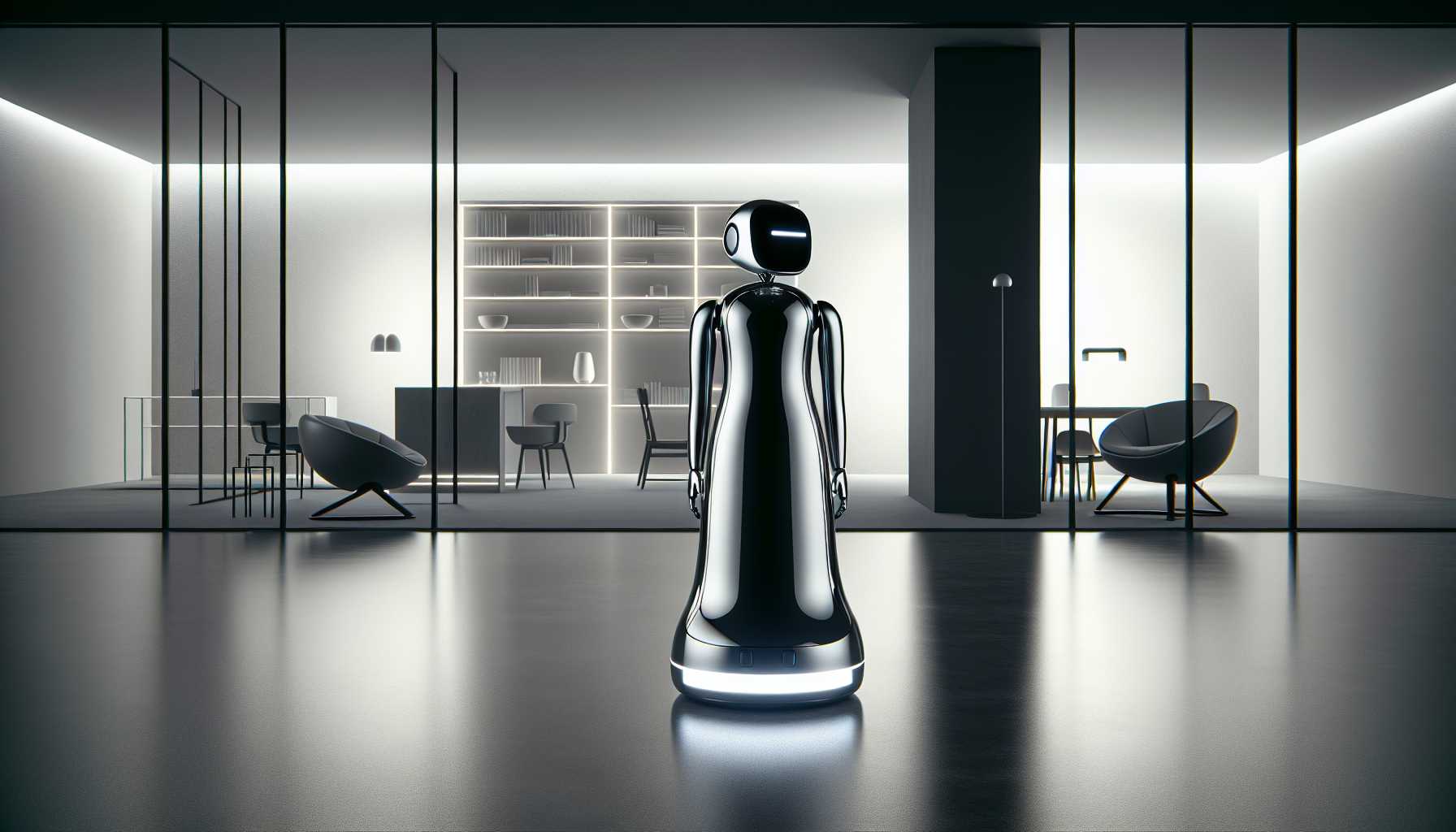
Apple, notorious for keeping its cards close to its chest, could be conjuring up something in robotics. If Mark Gurman of Bloomberg got his scoop right, Apple isn’t just aiming for the roads with its electric vehicle aspirations; it’s prepping a home-bound trotting robot and a tabletop device ambitiously integrating robotic movements to manipulate a screen.
For tech enthusiasts like us, this is tantalizing intelligence. It points toward a future where personal robots might become as common as smartphones, another testament to the blurring lines between what’s considered a gadget and a personal assistant. While specifics are as sparse as an exoplanet’s atmosphere, this news alone is enough to set imaginations – and stock-markets – aflutter.
To conclude, the tech cosmos is brimming with narratives that could rival any space opera; whether it’s time-warping on the Moon, quantum computing breakthroughs, AI musical smithery, or Apple’s robot rendezvous, the future seems to be scripted in code. Stay tuned, for the wonders of technology cease not.