
Aligning Product Goals with Business Strategy: A Product Manager’s Toolkit
As a seasoned product manager in the tech industry, I’ve walked a path beset with the challenge of aligning product goals with overarching business strategies. It’s a task that straddles high-level strategic planning and the nitty-gritty of day-to-day execution. Over the years, I’ve honed a toolkit of frameworks and practices that ensure this alignment, which I believe can help fellow product leaders steer their ships through the choppy waters of corporate strategy alignment.
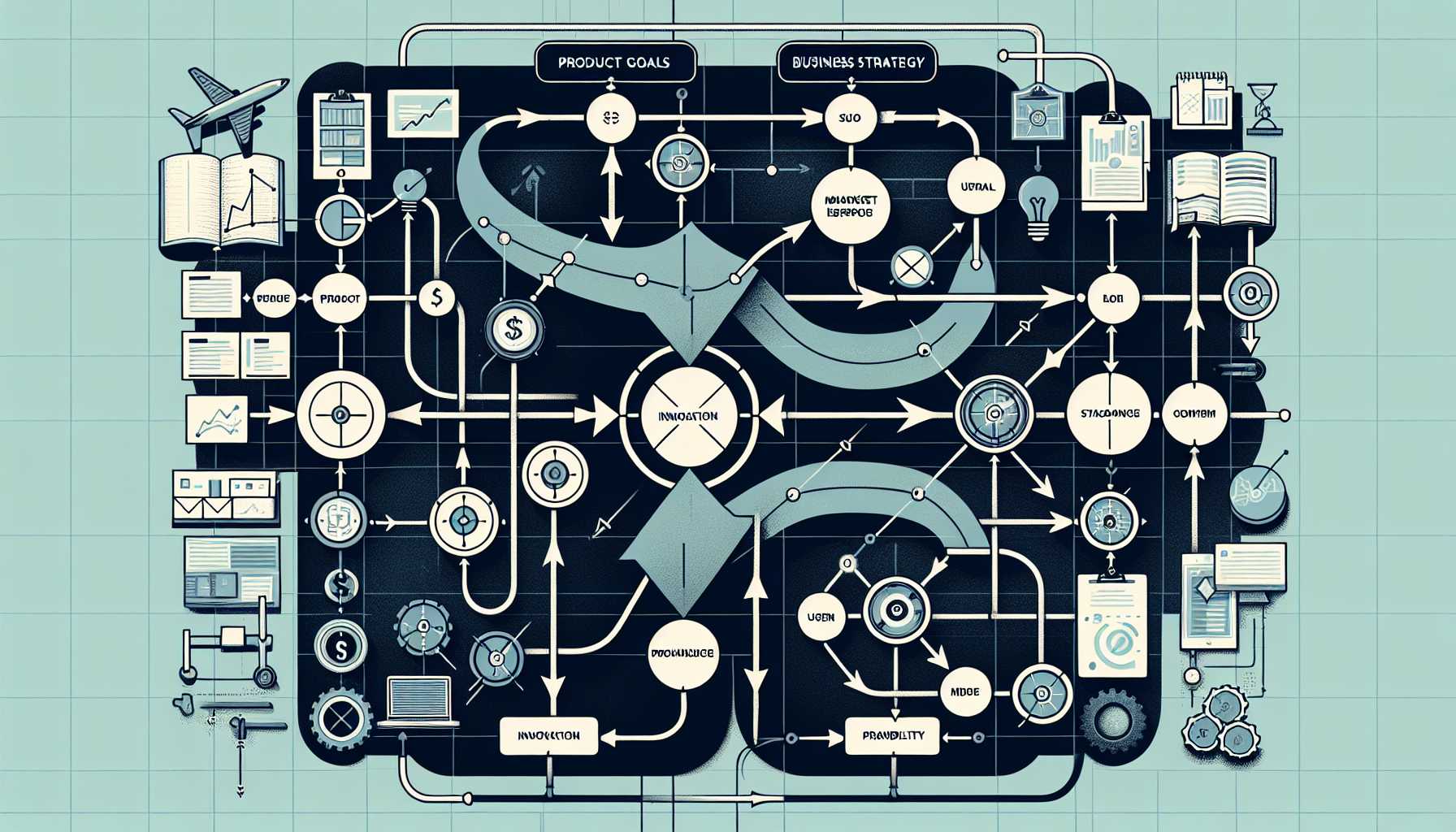
Understand the Business Strategy
The first step, unsurprisingly, is to deeply understand the business strategy at play. This goes beyond skimming the company’s mission statement or its latest quarterly report. It involves active engagement with top-level executives to grasp the long-term vision, market positioning objectives, growth targets, and financial models that underpin the company’s trajectory.
Personal Experience: In my tenure with an emerging fintech startup, the company decided to shift from a consumer-focused model to a B2B strategy. This monumental shift meant we had to revisit our product roadmap completely. By closely collaborating with the CEO and CFO, we identified the specific business objectives our products needed to address—scalability, regulatory compliance, and customer acquisition costs.
Translate Strategy into Product Goals
Once the business strategy is crystal clear, translating it into actionable product goals is the bridge-building exercise. I rely on frameworks like the Objectives and Key Results (OKRs) to distill the strategy into measurable outcomes.
For example, if the business strategy involves penetrating a new market segment, a corresponding product goal might be to ‘increase product adaptability towards market segment X by Q3’. Beneath this, key results would flesh out user acquisition targets, feature development milestones, and KPIs for customer satisfaction.
Personal Experience: When my team was tasked with tailoring our analytics platform for the healthcare industry, establishing firm OKRs grounded in the business strategy meant that every sprint planning session had clear signposts. Our OKR might have looked like “Achieve a 25% market share in the healthcare analytics sector within 12 months” with key results involving specific integrations necessary for the healthcare domain, compliance checkpoints, and user engagement metrics.
Align Roadmaps and Resources
Once product goals are set, the product roadmap becomes the narrative that will convey how those goals will be achieved over time. This is also the moment to ensure that the resources—you know, the people, the money, the technology—are in place to make them happen.
In my last role at a SaaS provider, our roadmap to integrate AI-driven features had to be tightly aligned with the newly secured investment earmarked for innovation. By setting transparent milestones and deliverables, we were able to justify the allocation of resources at each phase of the roadmap while also maintaining the agility needed to pivot or accelerate based on the ongoing learnings.
Incorporate Feedback Loops
A vital part of ensuring alignment is establishing feedback loops. Frequent checkpoints with stakeholders—spanning from the engineering team to the sales department—ensure that product development does not veer off course from business objectives.
In a past project, we leveraged bi-weekly cross-functional meetings that served as alignment sessions, where the implications of new user feedback or competitive movements were discussed against our product strategy. It was like a live, ongoing ‘sanity check’ that kept the product aligned with the business strategy.
Adapt and Communicate
Lastly, one must be prepared to adapt. The business environment is dynamic, and the alignment process is ongoing. Clear and regular communication channels within and outside the product team are the lifeblood of keeping everyone aligned with changes.
There was an instance in my career when a significant market event—a competitor’s game-changing product launch—meant we had to reconsider our entire product trajectory swiftly. By calling an emergency alignment meeting and openly discussing the implications, we were able to adjust our trajectory and communicate the changes throughout the organization effectively.
The overarching lesson is that alignment is not a one-off exercise—it’s a continuous cycle of understanding, translating, aligning, incorporating feedback, and communicating. By rigorously applying these practices and learning from each encounter, the alignment of product goals with business strategy becomes not just aspirational, but practically attainable.